

Editing Out Equality
From boardrooms to budget cuts, how we are losing the language required to name -and resolve the gender gap.

For years, “Believe Women” stood as the rallying cry for the #MeToo movement.
But Joanne Lipman, journalist and veteran observer of women in the workforce for over a decade, warns of a disturbing shift in her recent New York Times essay. This ‘defining message’ has been replaced by a new one:
Erase Women.
The change isn’t a loud, public reversal, but a quiet, institutional scrubbing. Discussions regarding gender have become so politically volatile that organizations now view the word “women” itself as a liability.
I read this article just before a meeting for the nascent Lattice Network with a group of women leaders. The timing was poignant. As we sat down to discuss leadership, access and influence, I was reading about how the very language we use to define our progress is being quietly deleted.
By way of context, I sit on the board of a national charity supporting women entrepreneurs. I work with women founders building companies. I facilitate peer mentoring with women through my local chamber of commerce. This is the water I swim in - not as a policy expert, but as someone who sees it up close, every week.
So when I started digging into the data, I wasn’t reading abstracts. I was reading about the scaffolding around the women I work with.
The venture capital numbers provide a grim baseline. Female-only founding teams received only 1% of total US venture capital in 2024. While the headline figure of $73.6 billion raised by female-founded companies in 2025 sounds like a record, the reality is skewed: nearly half that capital flowed to just two AI giants - Anthropic (co-founded by Daniela Amodei) and Scale AI (co-founded by Lucy Guo). Without those massive outliers, the “record” vanishes.
The point I want to make here is that te funding picture hasn’t moved meaningfully in a decade despite years of programs, pledges, and public commitments designed to shift it. Those programs are now quietly disappearing. And the conversation about why the numbers haven’t moved has become harder to have.
In corporate boardrooms, the retreat is evident in what companies choose to report - or not.
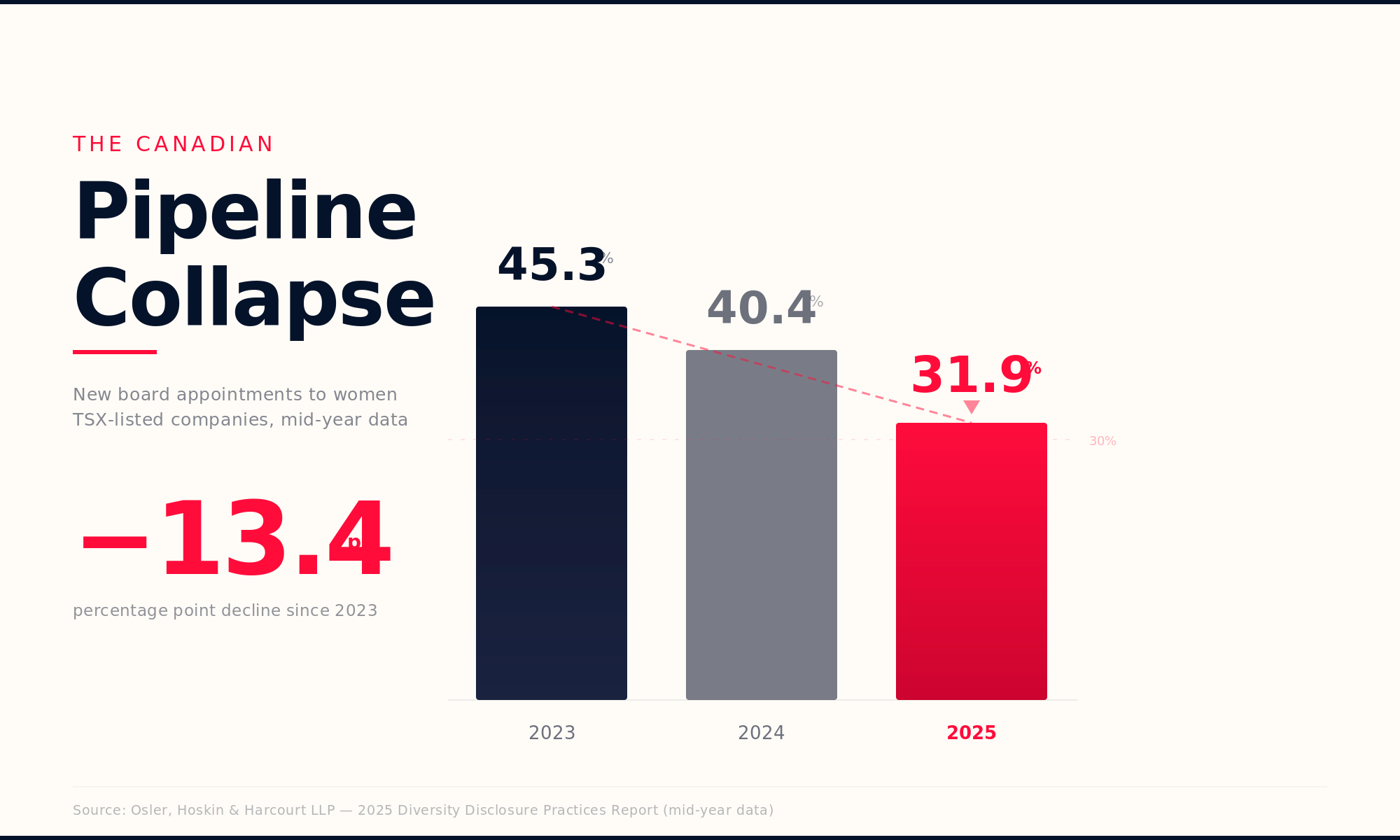
In Canada, representation looks stable only because turnover is slow - women reached 30.5% of TSX board seats in 2025. But the pipeline is collapsing: the share of new board seats going to women dropped from 45.3% in 2023 to just 31.9% in 2025.
Meanwhile, mentions of “DEI” across corporate Canada have plummeted 79% since mid-2024. Shopify eliminated several diversity programs. The Canadian Securities Administrators even paused changes to diversity disclosure requirements in April 2025.
In the US, the trend is even sharper. A recent study by the Conference Board and Harvard Law showed that US companies reporting data on women in management fell from 71.2% to 55.1% in a single year. Disclosure of female board members dropped from 90.5% to 60.4% !
These companies haven’t suddenly stopped hiring women; they’ve simply stopped measuring whether they are succeeding.
Stanford sociologist Shelley Correll points out organizations are starting to cancel Employee Resource Groups. She describes this as an “overreaction to what even Trump is asking them to do”. It is an overreaction to political pressure, using convenience as cover for a lack of commitment.
The institutional picture in Canada is harder to look at.
The federal government’s Women and Gender Equality department — WAGE — is facing budget cuts of roughly 80%. The National Action Plan to End Gender-Based Violence, which funds transfers to the provinces, effectively falls to zero. The National Association of Women and the Law called it a move that would “effectively gut the entire department responsible for women’s rights and gender equality.”
In the most recent federal budget, only 4.5% of budget measures were specifically targeted toward women. Twenty-five percent targeted men. Canada has a Gender Budgeting Act. We have mandatory Gender-Based Analysis applied to Cabinet decisions, Treasury Board submissions, and budget proposals. The architecture exists. The funding is being hollowed out underneath it.
The reach of this “erasure” extends into the nonprofit sector.
A 2025 piece in The Philanthropist documented what’s happening to nonprofits that serve women, racialized, and Indigenous communities. Organizations are self-censoring their language and mission statements — rewriting how they describe their own work — to avoid being seen as too political and losing their funding. Service capacity is shrinking. Staff are burning out. And the community trust that takes years to build disappears alongside the programs.
One of the people quoted in that piece put it better than I can: “It is not that there is an attack on DEI that is worrisome; it is the success of that attack that is worrisome.” — Sudip Minhas, Settlement Assistance and Family Support Services.
In the United States, some specifics are worth knowing.
The Equal Employment Opportunity Commission — the US federal agency responsible for enforcing workplace anti-discrimination laws — sued a Coca-Cola distributor for hosting a women’s networking retreat, alleging it discriminated against men.
Defense Secretary Pete Hegseth blocked the promotions of Black and female military officers, eliminated the Defence Advisory Committee on Women in the Services (which had operated for over 70 years), and axed the Women, Peace and Security Program. For the first time, there is no woman at four-star rank in the US military.
At the UN Commission on the Status of Women in March, the United States cast the sole vote against the Agreed Conclusions — a document adopted by consensus for eighty years. The US delegation had submitted over 90 amendments, including a proposal to narrow the definition of “gender” to mean only “men and women.” It failed, 37 to 1.
This matters beyond US borders. Canadian corporate and regulatory behaviour already tracks US developments closely — the CSA’s decision to pause diversity disclosure requirements being one example. The assumption that this stays south of the border seems increasingly optimistic.
I’m not a policy expert. My vantage point is specific: I see women building companies, raising capital, working within systems that weren’t built with them in mind. I see what changes when the support structures around them shift.
What I see right now is a gap forming between what’s happening inside organizations and what can be said out loud. Real damage happens there — not through dramatic reversals but through quiet ones. A policy removed. A report no longer filed. A program rebranded into something that no longer has to prove it works for the people it was designed to help.
Lipman references the work of Erica Chenoweth and Zoe Marks, two political scientists at Harvard who’ve studied the relationship between women’s participation and democratic resilience. Their core finding, published in Foreign Affairs: when women participate in movements in significant numbers, those movements are more likely to succeed and more likely to produce egalitarian outcomes. Authoritarian and authoritarian-leaning leaders have a structural incentive to suppress women’s participation. It’s not incidental to the playbook. It’s a feature of it.
Their argument is that reversing progress on gender equality is a hallmark of authoritarian governance worldwide — Turkey, Russia, Hungary all have their versions. The Canadian version is quieter. We’re not decriminalizing domestic violence. We’re defunding the department that fights it. We’re not saying women aren’t equal. We’re removing the language that lets us check whether they are.
I don’t have a policy prescription for any of this. I don’t think the answer is simply “more programs” — Dobbin and Kalev’s research at Harvard has shown that many traditional diversity programs don’t move the needle anyway. What does work, according to their decades of data: formal mentorship, skills training available to everyone, structural changes to how organizations recruit and promote. Work that doesn’t need to be labelled “DEI” to be effective — but does need to be measured to prove it is.
When we shrink our “institutional dictionary”—when “women” becomes a word you cannot use in a grant application or a mission statement—we don’t solve the problem. We simply lose the language required to see it.
I think about this for my daughter, who’s eleven. I wrote about her on International Women’s Day — the report card on where things stand. Education: A. Legal rights: D. Political representation: F. Funding the future: D.
The grades haven’t changed. What’s changed is the willingness of institutions to keep tracking them.
The scaffolding around women’s participation in public and economic life — the measurement, the funding, the language — isn’t decoration. It’s load-bearing.
And it’s being quietly removed.
What I’m reading on this:
Joanne Lipman, “I’ve Covered Women in the Workplace for 15 Years. Something Alarming Is Happening” (New York Times, April 6, 2026)
Erica Chenoweth and Zoe Marks, “Revenge of the Patriarchs” (Foreign Affairs, March/April 2022)
NAWL, “Feminist organizations denounce 80% funding cuts to Women and Gender Equality Canada”
NUPGE, “Budget 2025 Analysis: Equity, Diversity, Inclusion, and Accessibility Focus”
UN Meetings Coverage, “Women’s Commission Annual Session Begins with Contentious Recorded Vote” (March 2026)